|

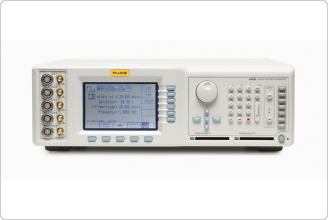

9500B Oscilloscope Calibrator
Automating oscilloscope calibration is possibly one of the biggest productivity enhancements that can be realised in many calibration labs. Performed manually, this work requires skilled operators to spend a substantial amount of time performing what are essentially repetitive tasks. Semi, or partial automation solutions apparently address this issue and free skilled technicians to perform more valuable tasks. However, in practice, these partial solutions present their own problems.
Over the last decade, the oscilloscope of choice has migrated from a two-channel instrument to a more complex four-channel device. When calibrating these instruments, it is necessary to move the calibrating signal from channel to channel as the procedure progresses. This can be achieved by physically moving cables, though this requires operator intervention. In high performance instruments, this may introduce additional measurement uncertainties as cables and connectors are handled. An alternative is to introduce a switching matrix to route signals, though this may result in problems with signal reflections, poor contacts and path differences that materially impact calibration uncertainties.